

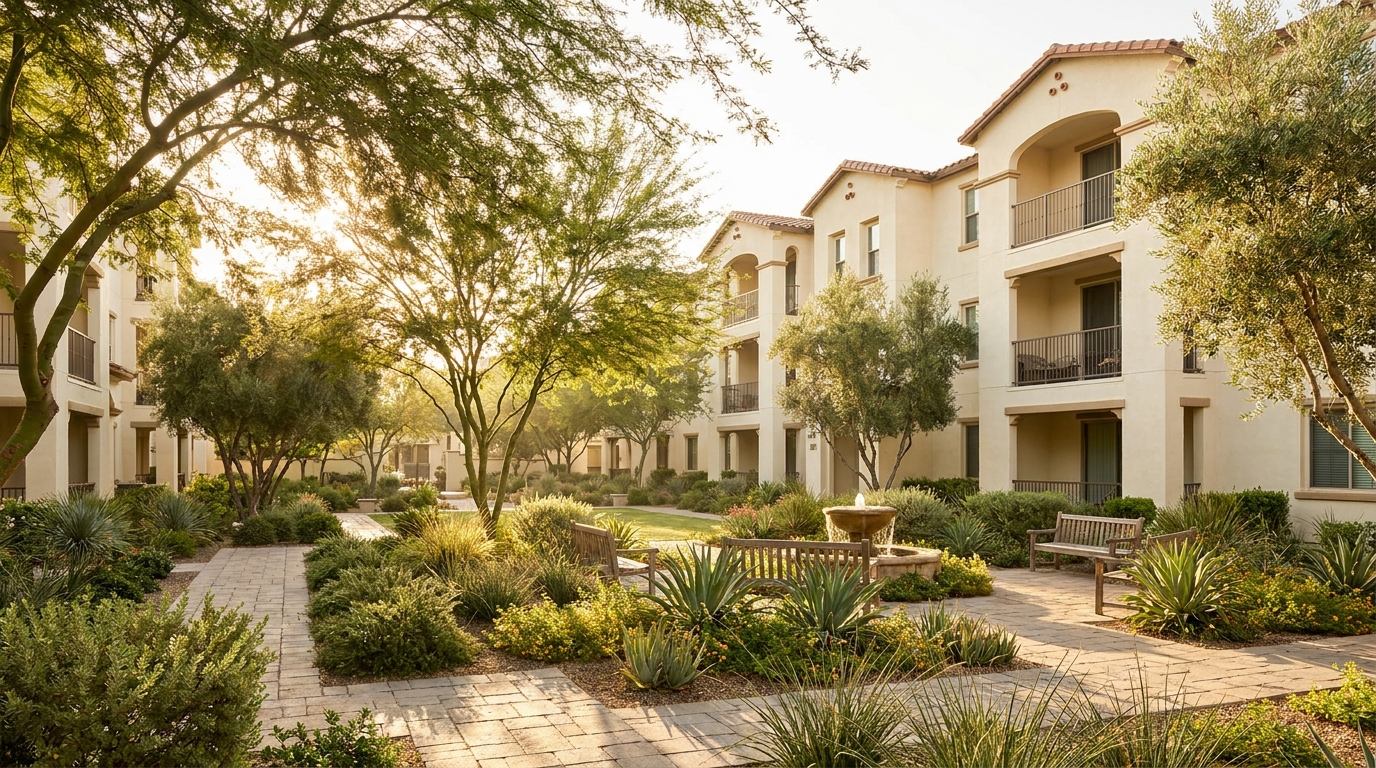
Most statements about responsible investment begin with a framework and end with a promise. Ours begins with a record. Two of the people who lead 4Front built the Gulf's most recognized sustainable communities before they managed outside capital, including the region's first net-zero energy community. That experience, not a policy document, is where our view of responsible capital comes from.
A record before a policy
When the people who set a house's standards have spent years delivering sustainable development at scale, the question of impact stops being abstract. It becomes practical: what does this investment build, who does it serve, and will it still be serving them in twenty years? We make no claims to scores or certifications here. We point instead to what has been built, and to the discipline that built it.
That restraint is deliberate. Language in this territory inflates quickly, and a regulated house serving families and institutions owes them precision more than enthusiasm. Where we cannot substantiate a claim, we do not make it. What we can substantiate is the work: communities designed, financed, and delivered, and still serving the people who live in them.
What responsible means in practice
For us, responsible capital rests on three habits. The first is the long horizon: judging an investment over decades rather than quarters changes what you are willing to own. The second is quality: an asset built well, financed prudently, and maintained with intent treats the place that hosts it better than one built to be sold quickly. The third is honesty about trade-offs: impact that does not survive a downturn helps no one, so the financial discipline comes first, not instead.
There is also a fourth habit, quieter than the others: refusal. Responsibility shows up most clearly in what a house declines to own. Assets that only work on a short horizon, leverage that manufactures a return rather than supports one, structures whose governance cannot be fixed before funding: declining these is not caution. It is the impact decision made early, where it costs least and protects most.
Impact that does not survive a downturn helps no one. The financial discipline comes first, not instead.
Shariah-compliant mandates
Responsibility also has a dimension of principle. Shariah-compliant mandates are available across our portfolio management, and where a structure must be compliant, it is built compliant from the outset rather than retrofitted. These mandates are held to the same standard of ambition and rigour as every other; principle and performance are not treated as a trade.
In structuring, that standard is architectural. Where a mandate requires compliance, the structure is designed compliant from its first draft, asset-backed and reviewed as such, rather than adapted after the fact. Retrofitted principle is usually weak principle; built-in principle tends to hold.
Development as impact
The clearest expression of responsible capital is what gets built. In Rwanda, that is affordable housing: institutional structure and financing discipline applied to the homes a fast-growing nation needs most. In Ghana, it is a masterplan on the Volta River conceived around medical, educational, sports, and historical tourism, development designed to serve a place rather than extract from it. In each case our role is the one we know best: structuring the capital and the partnerships through which the work is brought to life.
Neither project is presented here as proof of anything beyond the pattern: capital applied where the need is structural rather than speculative, in partnership with the people closest to the place, and held to the same underwriting standard as any other asset in the portfolio. Development of this kind is slower and less photogenic than a skyline, and it is where the long view earns its keep.
Who this is really for
The quiet audience for all of this is the next generation. The families we work with are rarely asking only what their capital will return; they are asking what it will stand for when it changes hands. Preparing a portfolio for succession and preparing it to be defensible in twenty years turn out to be the same exercise: both reward assets of genuine quality, structures that hold, and a record that can be explained without embarrassment.
The discipline that makes it durable
None of this suspends the rules that govern the rest of our work. Assets are entered at a protective basis, leverage is sized to cash flow, governance is fixed before funding, and everything is managed within a CMA-regulated framework. Responsible capital is still capital. It is precisely because the discipline holds that the impact lasts.
The long view
The families we serve tend to measure success in generations: a legacy preserved, an institution strengthened, a next generation provided for. Capital managed on that horizon is naturally drawn to investments that improve the world they touch, because over decades, the two are the same question. That is the sense in which we practice responsible capital: not as a separate product, but as the long view, held with discipline.
It is also why the subject sits inside our thinking on approach and development rather than on a page of its own. Responsibility that lives in a separate section of a website is decoration. Responsibility that lives inside the capital stack, the mandate, and the business plan is practice, and practice is the only version of it we consider worth writing about.